Digging for Water: Indigenous poet Jake Skeets’s “Horses” as Reclamation of Stolen Language and Ode to Diné Survival
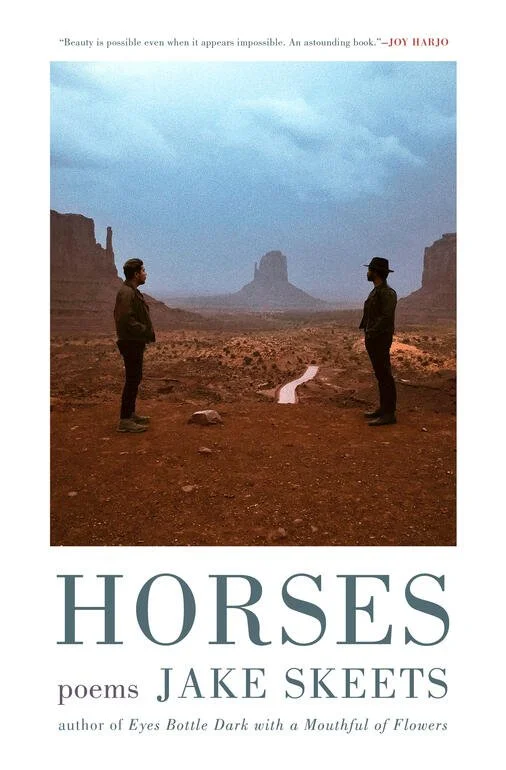
In Horses (Milkweed 2026), Navajo Nation Poet Laureate Jake Skeets carries readers across an ever-changing landscape and home to the Diné (name literally meaning “the people”), an Indigenous People of the American Southwest, since time immemorial. As in his previous full-length poetry collection–Eyes Bottle Dark With A Mouthful of Flowers (Milkweed 2019), winner of the National Poetry Series, American Book Award, and Kate Tufts Discovery Award–Skeets writes of his people who still live on a landscape scarred by violence, reclaiming said place through a steady rootedness in Diné history, thought, and culture. He navigates through burning coal, thigh-deep mud, overgrown red brome, and blue horses as both person and poet. With apocalypse near and the age of the Anthropocene in question, existential grief reverberates alongside personal pain, making Horses a poetic prayerbook and travel guide at the same time. Still, in this collection starting with an encounter with nearly two hundred dead horses, Skeets’ lyrics sing with precise language and emotional resonance, calling to all contemporary poetry readers living in a world that increasingly needs more song, attentive care, and protection over sacred memory.
In the first of four sections within Horses, Skeets begins with a twelve-part poem imbued with specificity of the land. He built important numbers, like twelve, from Diné culture into the structure of the book. In “Part Eleven Declaration,” the speaker proudly names a closeness with local flora and geology that live between the Four Sacred Mountains of the Navajo Nation. Using a list form, Skeets writes:
I am a stream of penstemon
salt flats
the song of water over rock
all gallows, only salt no pond or fog
no river
only sound.
This poem, inspired from a writing exercise designed by fellow Diné poet, Kinsale Drake, evokes the sameness between animate beings via image. By putting nouns from nature like the above, as well as “saguaro tall,” “cliff jade,” and “moth wind” next to the speaker’s declaration of themselves, Skeets announces a connection born millennia ago and that will continue into the future, even as the landscape evolves. There is no such thing as wilderness here; everything is home.
Horses also features “A Failed Glossary” with translations—or refractions, as Skeets borrows from Jennifer S. Cheng—between English and Diné Bizaad (Navajo Language). One poem that particularly highlights bilingualism is “Anthropocene: A Dictionary.” Here Skeets opens a window to all readers, providing a tool especially necessary for anyone who has lost access to Diné Bizaad, including himself, in order to relearn what was stolen from them. He writes:
nihootsoii
: evening—somewhere northward fire
twists around the shrublands;
sky dipped in smoke—twilight
—there is a word for this,
someone says
: deidííłid, they burned it
: kódeiilyaa, we did this.
Skeets uses an anthropological approach as opposed to a linguistic one here, focusing this dictionary on cultural contexts, stories, and practices in lieu of etymological factoids to create this opening, this opportunity for (re)connection to language. What has happened and is happening in the Navajo Nation is important history to readers of all language backgrounds. With intentionally placed punctuation and white space, Skeets invites non-native Diné Bizaad speakers to inhabit non-dominant offerings of perception that might be askew to more familiar, dominant ones. At the top of “A Failed Glossary,” Skeets writes, “the only true glossary you need for this book is your ear or your eye. Perhaps, the small grooves ink makes on paper that you can feel when you trace your finger along the word’s shape.” Skeets’ journey through language to get closer to meaning and truth is guided by his body. Attentiveness towards one’s senses, the breath, and corporeal experience of living within a landscape are tools all of us humans need to hold onto tightly if we’re to extend the Anthropocene.
“Hootso,” Diné for meadow, is the collection’s second section and features a series of poems all titled starting with “if,” such as: “If Emergence,” “If Horses Named Weather,” “If The End of the World,” “If Field,” and “If Hope What Then of Its Body.” In “If Senses,” by far the longest poem within “Hootso,” the speaker instructs the reader to use their senses to witness, experience, and immerse themselves into the minute details of place. Skeets charges the reader to “smell// horses digging for water” and “see silo// grain lost to echo.” The fully lowercase poem does not have an overly-commanding tone, and yet, the specificity of the subject matter is often uncomfortable, or perhaps easy (emotionally and physically) to overlook. It’s not fun or pleasant to “taste[…]igneous rock water runoff an oil spill” or “touch[…]rift-sawn sand” and yet the speaker insists that the reader must engage alongside him, diving into these processes and experiences with their imagination if they cannot in real life. Sensation and awareness of oneself within a larger world is necessary for survival, for connecting past, present, and future. Without an intimacy with our landscape—no matter how rural or urban—we will lose ourselves.
Jake Skeets’s Horses is an elegy for the tragedy of the free-roaming animals found mud-caked in a circle, all upright, all dead. The collection, rooted in relationality, is also an ode to the one horse who survived, named Grace, and the continually evolving home to her and the Diné people. As cornfields turn into sand, as increasing winds lead to more abundant rain and snow, as the human population navigates systemic harm done to them and the land, there is still a future all of life points to. With sharp-eyed poetics, intimacy with history, and attentiveness to the sensorial, Jake Skeets offers readers an astounding and haunting second collection, changing the landscape of contemporary poetics once again.
Jake Skeets: Horses. Milkweed Editions, Minneapolis 2026. 152 pages, paperback, $18,–.