wild Songs further to utter. John Berryman and the Dream Songs
my whole force hoofing for the ground
It seems natural to tell the story of the poet John Berryman from its conclusion, for that is ultimately how he himself recounted it in his numerous, death-obsessed poems. For him, almost from the very beginning, everything was overshadowed by the spectre of an inevitable catastrophe, until he finally brought it about himself. A self-fulfilling prophecy that culminated in that night on 7 January 1972, when he walked onto the Washington Avenue Bridge in Minneapolis. “… that night that we thought John Berryman could fly/ But he didn’t, so he died”, sings Craig Finn in “Stuck Between Stations”, the opening track on the 2006 album *Boys and Girls in America* by the band The Hold Steady. The very same moment that Robert Lowell described in a text dedicated to his friend’s memory, published just a few months after his suicide, as an “icy leap from the bridge to the hard ground”[1] . The proverbial rifle from whose barrel a shot is fired in the third act – Berryman himself had hung it on the wall in the first act.
John Berryman was one of those ‘emotionally-tied-in-knots animal’[2] of whom Marianne Moore speaks in her poem ‘To A Giraffe’, a text that can be read as a reckoning with the representatives of so-called Confessional Poetry, a rapidly popularising movement within American poetry of the late 1950s and early 1960s. The critic M. L. Rosenthal coined the unloved term in a review he wrote in 1959 for the magazine The Nation; the focus was on Robert Lowell’s collection Life Studies. Very soon, the poets W. D. Snodgrass and Anne Sexton were also classified as belonging to this movement. What they had in common was that they placed their own personalities at the centre of their poems and crossed the boundary into the private, indeed the all-too-private.
Berryman arrived at this gathering of ‘confessional’ poets five years late, and he was a surprise guest, having until then been regarded as a follower of T.S. Eliot’s thesis that poetry is not an expression of personality, but rather an escape from it. However, he did not come alone; he was accompanied by two peculiar men. The first bore a striking resemblance to Berryman, right down to the flyaway whiskers; they even resembled one another in their outward demeanour (though it was not entirely clear who was actually imitating whom); he was talkative and somewhat eccentric; he always spoke of himself in the third person, calling himself Henry; half the time one could not make out what he was saying, even though he spoke very, very slowly—indeed, he was actually singing, but in an almost provocatively slow-motion manner. The second was taciturn; he did not reveal his name to us, not even to this day; he always addressed the first, Henry, as Mr Bones. From time to time he corrected him; sometimes, whenever it became necessary, a gentle rebuke followed. The whole thing had the air of a routine developed over the years, a well-rehearsed back-and-forth, of which those standing around never knew exactly whether it was meant to make them laugh or cry. Together, the three of them (Berryman, Henry and the nameless one) delivered an unusual gift: the 77 Dream Songs. Moreover, strangely enough, there was an elephant in the room the whole time, although it wasn’t actually its presence that was strange, but rather the fact that nobody seemed to notice it.
Henry, who was always a crash programme
Henry is the mask through which John Berryman speaks in his *Dream Songs*, just as the poet Robert Browning chose masks for his dramatic monologues – mostly historical figures, hypocrites or geniuses – to whom he lent his voice. In a preface to the Dream Songs, Berryman describes this Henry as an ‘imaginary character (not the poet, not me)’[3] . Indeed, he insists so emphatically that he is not Henry that readers are quite justified in beginning to harbour doubts. For both Berryman and his creation Henry admired the same men (e.g. Gerard Manley Hopkins or Stephen Crane), married the same women, fathered the same children (including Paul and Martha, referred to as Pou and Twissy respectively in the Dream Songs) and cultivated the same friendships (with, for example, Saul Bellow or Delmore Schwartz). Both had a father who took his own life when they were eleven years old, and it seems as though both derived a set of instructions from this for themselves, the end of which was, in turn, to be suicide. “If life is a handkerchief sandwich,” it says in “Dream Song 76”, “in a modesty of death I join my father/ who dared so long ago to leave me”.
The principle of the Dream Songs is that John Berryman speaks through a John-Berryman mask, just as Éric Cantona wears an Éric-Cantona mask at the end of the film Looking For Eric. Henry, however, could also be described as a sort of ventriloquist’s dummy, modelled on the puppeteer (Berryman) on a smaller scale. The Berryman-Henry puppet sits on Berryman’s knee, and it says and sings what he thinks. But wh , what if the relationship is reversed and the image Berryman constructs of himself as Henry gradually overlays reality? It is like in Ventriloquist Dummy Horror, a subgenre of the classic horror film based on the phenomenon of uncanny mirroring, whereby the reflection or imitation by a counterpart leads to a feeling of increasing unease.
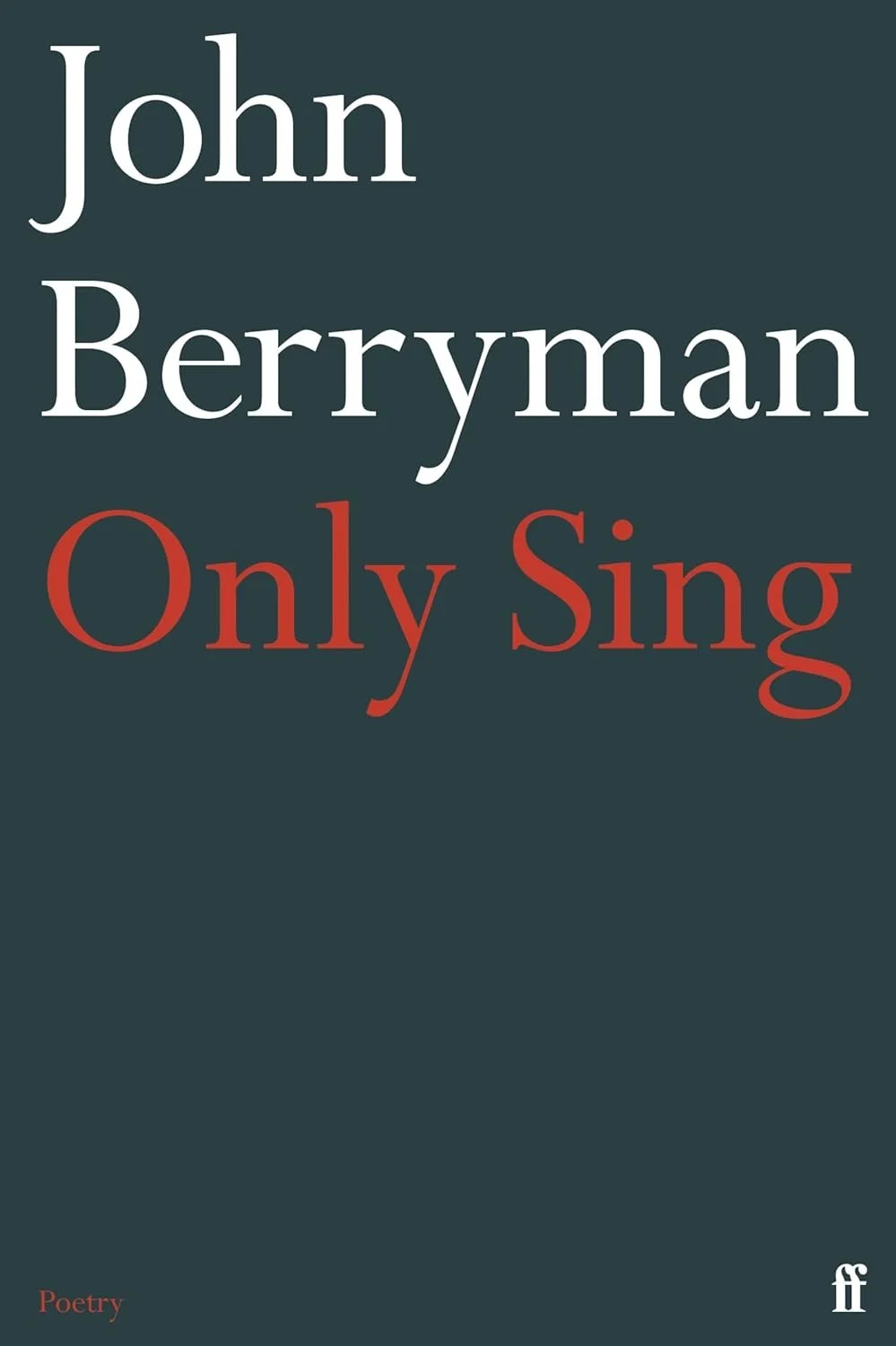
And yet here were two people who had found one another and could not bear to be apart, as if their thoughts were in perfect sync and vital organs – an alcoholic fatty liver here, a doll’s heart there – had been transplanted into each other’s bodies. Four years after the first 77 Dream Songs, His Toy, His Dream, His Rest was published in 1968, a volume containing 308 additional songs.[4] But that was not all; after Berryman’s death, further Dream Songs were discovered in his estate. A volume featuring a selection compiled by John Haffenden was published in 1977: Henry’s Fate and Other Poems. It included 45 previously unpublished Dream Songs. Another volume, which provided the inspiration for this essay, was published by Shane McCrae at the end of last year: Only Sing, 152 Uncollected Dream Songs.[5] Berryman had never stopped writing these poems, although his ventriloquist’s dummy in “Dream Song 356” says of itself (and Berryman?): ‘There was a time he marched from dream to dream/ but he seems to be out of ink’. And at the end of “Dream Song 379”, Henry prophesies: “I will not come again/ or not come with this style.” A prophecy that was only partly fulfilled; after all, Henry possessed an extraordinary talent for unexpected comebacks. Yet another trait he shared with his creator.
There are now a total of 582 Dream Songs. Keep on counting.
excellence & loss
The themes explored in the Dream Songs revolve around variations on topics that have long been established within confessional poetry: these range from the usual family and domestic disasters to erotic entanglements, adultery, divorce, madness and death. Added to this is the habitual abuse of alcohol, which features in every other Dream Song, from ‘Man, I been thirsty’ through ‘we’ll meander as far as the bar’ and ‘Drink & sing seems all our fate obliges’ to the refrain of his later years, which seems to take well-meaning advice to heart: “Reduce booze. Reduce… booze? Reduce… booze”; only to end up back at the original realisation: “Some people seem to need another drink.”
So far, so familiar: Berryman’s Henry follows that blueprint of the white man drinking himself to death, which spawned so many offshoots in the 20th century. The innovations occur in other areas, on the one hand through the tone struck here, and on the other through the presentation within the framework of an almost theatrical production with assigned roles. The Dream Songs are, after all, not a Browning-style monologue; they are dialogical in their structure. And here the Nameless One comes into play again, as does the elephant mentioned at the outset, which stands seemingly unnoticed in the room. The Nameless One takes on the role of straight man for the goofball Henry; he is to him what Carl Reiner was to Mel Brooks, what Dean Martin was to Jerry Lewis. His function is that of a corrective. His interventions are calls to order or commenting asides, mostly drawing on common soothing phrases. As a rule, they are introduced by the Nameless One addressing his counterpart by his nickname: Mr Bones. It sounds something like this, for example:
– Mr Bones, take it easy.
[…]
– Mr Bones, hold your breath
[…]
– Ah see, / , Mr Bones: you’s remorse’.
[…]
– You’re confusing yoursel’, Mr Bones.
[…]
– Mr Bones, are you all right?
[…]
– Mr Bones, be humble.
And sometimes like this:
– Mr Bones, you terrify me.
[…]
– Happy New Year, Mr Bones.
Henry’s extravagances and excesses, his sentimentality and pathos, are thus objectified by a neutral yet sympathetic interlocutor. The effect is astonishingly funny, a fact that makes Berryman an exceptional figure amongst the practitioners of Confessional Poetry. Robert Lowell writes in a poem in which he addresses his dead friend directly: ‘Just the other day/ I discovered how we differ – humour …’[6] (It is curious that in an early review of the Dream Songs, which was rather critical in tone, Lowell assumes that Henry’s interlocutor is Mr Bones himself. A mistake he later corrected.)
But back to the elephant, which still stands where we first found it. Its presence is linked to a crucial flaw in the Dream Songs, which has two causes: On the one hand, Berryman uses the historical minstrel shows as a backdrop for the dialogic scenes; on the other, he makes extensive use of African American Vernacular English (AAVE), a distinct variety of English prevalent within the African American population in the United States of America.
In a minstrel show, three main characters met on stage. In the centre stands the Interlocutor, who acts as master of ceremonies; he also serves as the contrasting figure to the two so-called Endmen, who take on the comic roles. They are so named because they take up their positions at the respective ends of the stage. Their names are derived from the instruments they play: Tambo (tambourine) and Bones (a kind of bone rattle). Their call-and-response dialogues give the shows their structure. All three perform in blackface; the highly dubious humour of their performances is based on racist stereotypes.
For his own purposes, Berryman removes the character of Tambo from the repertoire; he confines himself to the, in his own way, sober interlocutor (Henry’s conversation partner) and to Mr Bones (Henry himself). The use of the minstrel show as a foil for the Dream Songs is one thing; more problematic, however, is that Berryman at no point gives any indication of being aware of the dubious context. Quite the contrary, in fact: the second Dream Song is, as stated in a note by the author prefacing the poems, dedicated to the memory of Daddy Rice, ‘who sang and jumped “Jim Crow” in Louisville in 1828’. Daddy Rice was the stage name of Thomas Dartmouth Rice, one of the most famous minstrel performers, who appeared in blackface, and Jim Crow is the stage character he invented and which made him so popular with the audience—a stereotypical portrayal of a black man who sings and dances. Later, the name Jim Crow became synonymous with ‘ ’ the segregation laws in the USA. It was not until the year the 77 Dream Songs were published that the Civil Rights Act was passed, prohibiting racial segregation in public facilities.
In connection with Daddy Rice, two thoughts immediately spring to mind. The first takes the form of a question: must one really dedicate a poem to the memory of such a man? The second takes the form of a simple observation: ouch.
It doesn’t get any better when, in ‘Dream Song 60’, Berryman protests against the persistent racism in the US, yet—as in the Daddy Rice poem—resorts to a highly artificial idiom that draws heavily on the aforementioned African American Vernacular English (AAVE):
After eight years, be less than eight per cent,
distinguish’ friend, of coloured wif de whites
in the school, in the South.
– Coloured lads, coloured officers,
Mr Bones. Is that nothing? – Uncle Tom,
shut your mouth,
a million people are being kept out of proper jobs,
the fair houses and the churches, you see
[...]
In these two Dream Songs and many others, Berryman is guilty of two offences that are closely linked: uncritical artistic appropriation and literary blackfacing. Now one might object – an objection that is actually raised more often than one might assume – that it was a different time back then and that perspectives on such matters have simply changed over the decades. It is more plausible, however, that for those who took offence even back then, there was little prospect of being heard.
Certainly, there is a long, inglorious list of historical works of art that predate the Dream Songs and conveyed racist content, either explicitly or at least in their underlying tone. These include, for instance, the blackface scenes in The Birth of a Nation, as well as the glorification of the Ku Klux Klan’s role within it. The stereotypical ‘Mammy’ character in Gone with the Wind also belongs in this context. Added to this are the so-called ‘Censored Eleven’ , a group of Warner Bros. animated films produced between 1930 and 1944 that contained obviously derogatory, stereotypical depictions of African-American characters – including films such as Coal Black and the Seven Dwarfs (1943) or Goldilocks and the Jivin’ Bears (1944). And of course there is, in the Walt Disney classic Dumbo, the small group of mocking crows, whose leader Dandy Crow (in the early scripts and storyboards he was still called “Jim Crow”) hands a black feather to the little elephant who suddenly finds himself in a tree canopy. These are, of course, merely examples from a time believed to be long past. What is astonishing, however, is how far this list can be extended from the recent past right up to the present day: for example, with the album cover of Don Juan’s Reckless Daughter from 1977, on which, of all people, the supposedly above-it-all Joni Mitchell poses in a pimp outfit as her blackface alter ego Art Nouveau, or the blackface appearances of the two late-night Jimmys (Kimmel and Fallon), who imitated black celebrities such as Snoop Dogg, Karl Malone or Chris Rock in sketches that were not even remotely funny. An interesting special case is the scandal surrounding the character of Apu Nahasapeemapetilon, the Kwik-E-Mart owner of Indian descent from The Simpsons. Like so many characters in the series, he was voiced by the white actor Hank Azaria. As criticism that Apu was a stereotypical portrayal of a South Asian person grew louder, Hank Azaria decided in 2020 that he no longer wished to lend his voice to the character. He also stated that he had in fact been imitating Peter Sellers, who had played the Indian film extra Hrundi V. Bakshi in the Blake Edwards comedy The Party (1968).
When Dick Cavett had the black comedian Richard Pryor as a guest on his talk show in 1985, he said: “I think I could write for you in your vernacular.” Pryor replied: “But what is my vernacular?” And the way he looked, shook his head and then shrugged his shoulders made it clear that any further questions were unnecessary.
He make their minds blur, with that syntax
I began reading John Berryman when, in the early 1990s, I came across some of his Dream Songs in an American anthology. I had never heard of him before, nor of Elizabeth Bishop and James Merrill, two poets whom I still love very much today and whose poems were printed in the same anthology. What I read was unprecedented and hitherto unheard of. My advanced English course at the time was no match for these texts— . I understood little, a circumstance that, however, only heightened the poems’ appeal. Nothing I had read before resembled these strange songs: “voicing & obsessed”. To me, having been brought up on comics, Henry sometimes sounded, at best, like George Herriman’s character Krazy Kat singing for Ignatz Mouse, in joyful anticipation of a brick from Kelly’s Brickyard that might strike him on the back of the head at any moment.
When I later bought the collected Dream Songs (which at the time had to be ordered through the foreign departments of bookshops and was a complicated process that – once set in motion – could take months), the difficulties in understanding multiplied. I spent months pondering the meaning of a line like “Some hang heavy on the sauce”. In “Dream Song 272”, the interlocutor says to Henry: “ – I really gotta go. You don't make sense.” And Henry replies: “ – I don’t try to. Get with it.” And in “Dream Song 366” it says: “These Songs are not meant to be understood, you understand./ They are only meant to terrify & and comfort.” And indeed, there was a certain comfort in the fact that I was relieved of the need to understand everything.
A key to the *Dream Songs* that I lacked at the time, and which I would only come to possess after reading the rest of John Berryman’s poetry collections, lay in the realisation that Berryman was a mannerist by necessity. His first collection of poems, *The Dispossessed* (1958), remained derivative, for Berryman stood in the shadow of his two literary idols, W. H. Auden and W. B. Yeats. For years, he was unable to escape their influence. This made it considerably more difficult for him to find that very distinctive tone which we still associate with Berryman today. Even into his later years, he retained a strong tendency towards the hagiographic, which went as far as self-denial. He was an unconditional admirer of famous men, whose obituaries he partly wrote in the *Dream Songs*: Robert Frost, Theodore Roethke, Randall Jarrell, William Carlos Williams and, above all, the poet Delmore Schwartz (“The new ghost haunting Henry most”). Berryman stylised Schwartz (who was immortalised as the “European Son” in the Velvet Underground song of the same name and later haunted Lou Reed’s house as a ghost) into a sort of mentor figure, even though Schwartz was only a year older than himself. “I love great men I love,” says Henry in “Dream Song 230”.
It is as though Berryman had to impose an idiosyncratic style on his poems in order to free himself from all these influences. Theodore Roethke once wrote: “I’ll make a broken music, or I’ll die.”[7] The same applies to Berryman. In a late poem “Olympus” from the collection Love & Fame, he approvingly quotes the critic R. P. Blackmur (yet another father figure he admired) at one point:
The art of poetry
is amply distinguished from the manufacture of verse
by the animating presence in the poetry
of a fresh idiom: language
so twisted & posed in a form
that it not only expresses the subject at hand
but adds to the stock of available reality.[8]
Here – broken into lines – the ideal that Berryman was to emulate is formulated in an exemplary manner, first in 1956 in the long poem ‘Homage to Mistress Bradstreet’ (a poem that, in its own way, is as magnificently misguided as Gerard Manley Hopkins’ ‘The Wreck of the Deutschland’, with which it also shares a number of other similarities) and finally in the Dream Songs. And only with the help of the Henry doll, which he places on his knee before he begins to sing – indeed, only through it – does he succeed in liberating the tone, that peculiar mixture of standard language, slang and AAVE, which is entirely his own and was to remain so; sometimes melodramatic, sometimes radically private, often funny, always heart-rending.
Anything can be fed into this ‘Henry system’, however disparate the subject matter (from Hannah Arendt and the Seven Gifts of the Holy Spirit, via Fatty Arbuckle and Mr Deeds’ tuba, to Apollo 8 and the first manned moon landing); it becomes plausible simply because it is the same puppet’s mouth that conveys it to the audience. Within the logic of these songs, it is by no means far-fetched for Lili Kahler and Albert Einstein to stand on equal footing alongside Shirley Jones and George C. Scott, or Calamity Jane and Wild Bill Hickok.
The poet Eugene Ostashevsky once told me that, to him, the Berryman of *Dream Songs* sounded exactly as Joseph Brodsky should have sounded in English translation. Robert Lowell, for his part, recognised the influence of Shakespeare, feeling particularly reminded of the “fragile passages”[9] in the late plays. In an interview, however, Berryman claimed:
“I seem to have been sort of untouched by Shakespeare, although I have had him in my mind since I was twenty years old.”[10]
If one looks at perhaps the most famous ‘Dream Song 29’, this claim can easily be refuted. It begins:
There sat down, once, a thing on Henry’s heart
só heavy, if he had a hundred years
& more, & weeping, sleepless, in all that time
Henry could not make good.
In Shakespeare’s *The Winter’s Tale*, Paulina speaks the following words to King Leontes after he has apparently caused the death of his wife Hermione:
— But, O thou tyrant,
Do not repent these things, for they are heavier
Than all thy woes can stir. Therefore betake thee
To nothing but despair. A thousand knees
Ten thousand years together, naked, fasting,
Upon a barren mountain, and still winter
In perpetual storm, could not move the gods
To look that way thou wert.
our hero arose, held, in pieces
After 1968, Berryman had folded his ventriloquist’s dummy Henry back into its little box, and the interlocutor retreated into the void between the wings.
The subsequent poems, collected in *Love & Fame* (1970) and *Delusions, etc.* (1972), had to manage without Henry as a middleman. Berryman’s egocentricity, his self-intoxication which grew ever more intense with the passing years, remained unfiltered by the absence of an intervening word-distorter. Without the linguistic tics and idiosyncrasies, the flavour-enhancing additions of slang, nonsense and baby talk, no new fire could be kindled. The late work returned to the flat realms of the early days. A circle that closed in an unsettling way. Added to this was a personal experience of spiritual awakening, which found expression in a series of religious poems. Yet, one thing at least is clear after reading these texts: John Berryman is not George Herbert. In ‘Dream Song 150’, Henry says of Delmore Schwartz’s work: ‘I’d bleed to say his lovely work improved/ but it is not so.’ A judgement that seems as though Berryman had unwittingly spoken it of himself. Yet another self-fulfilling prophecy.
Henry, however, could not be suppressed indefinitely; he proved to be a veritable jack-in-the-box who kept popping out of the box during Berryman’s final years. In interviews, Berryman himself occasionally hinted that there were many Dream Songs written later on that were to be included in the existing body of work after his death. The posthumous poems, which now reach us after a considerable lapse of time (after all, 48 years lie between the publication of *Henry’s Fate and Other Poems* and *Only Sing*), are of highly variable quality—an observation that carries little weight, however, as it applies just as much to the original 385 *Dream Songs*. With Henry, it was always hit or miss. So we get more of what we already know: “Death […] is the word;/ death & sex.” It concerns his companions William, Cal and Saul (easily identifiable as Meredith, Lowell and Bellow respectively), late fame (“the applause of the World comes to an empty heart”) and, time and again, his father’s suicide, the central theme of the Dream Songs:
He saw the images start, 3D, with sound,
in affect-depth. His father, just before
he killed himself & was found,
Vincent Van Gogh, off. All the grief he ever tore
from women, one’d. his son’s worst moment. His own
gross little failure.
And:
Until the end. He threatened, raged, and cursed.
The brokers were hurling themselves from the upper floors,
Davis Island was half-mad.
He said he’d swim out too far with my little brother or me,
he said he hated her – that was the worst –
then went to work with the pistol he had.
We see Henry drinking tea with Yeats at the Athenaeum Club in London (an anecdote that has already crept into one or two poems before), and visit with him the graves of Dante, Shakespeare and Keats, all the great men in whose shadow he so loved to stand.
More of the same, then? Yes, and yet some of the Dream Songs now published seem unfinished. This is apparent at first glance; every breach of the rules immediately catches the eye, for the form Berryman chose is no less strict than the Chevy Chase stanza or the Spencer stanza. As Berryman himself wrote, it is a kind of extended sonnet consisting of three six-line stanzas with a fixed number of stresses: 5 - 5 - 3 - 5 - 5 - 3. The editor, Shane McCrae, writes in a foreword that some of the songs read as though Berryman had reached the end of the poem before he could fulfil the form. Well, perhaps, but that is nothing more than a euphemistic description of what we would do better to call a fragment.
In ‘Dream Song 297’, Berryman has Henry say: ‘I perfect my metres/ until no mosquito can get through’. A somewhat bold claim, considering he was quite prepared to handle the form more freely in exceptional cases. Here, however, the situation is different: swarms of mosquitoes swarm through some of the posthumous songs. Yet every additional song delights the heart of a true Berrymaniac.
“I’m almost done. I’m almost done,” says Henry in one of the new poems, which is quite clearly nearing its conclusion. And his interlocutor replies: “I’m listening, Mr Bones.”
And that is exactly what we are doing. We are listening.
Henry is singing again. Apu Nahasapeemapetilon has been silent for six years.
[1] Robert Lowell: ‘For John Berryman’, in: *Berryman’s Understanding: Reflections on the Poetry of John Berryman*, edited by Harry Thomas, Northeastern University Press 1988, p. 70.
[2] Marianne Moore: To A Giraffe, in: The Poems of Marianne Moore, edited by Grace Schulman, Faber and Faber, London 2003, p. 336.
[3] John Berryman: The Dream Songs. The Noonday Press, Farrar, Straus and Giroux, New York 1994, p. vi.
[4] All Dream Songs published during his lifetime are included in the 1994 edition (see note 3).
[5] John Berryman: Henry’s Fate and Other Poems, ed. by John Haffenden, Faber and Faber, London 1978; John Berryman: Only Sing, 152 Uncollected Dream Songs, edited by Shane McCrae, Farrar, Straus and Giroux, New York 2025. The Dream Songs quoted here are taken from these two editions and the 1994 edition (see note 3).
[6] Robert Lowell: For John Berryman, in: Poems. Klett-Cotta, Stuttgart 1982, p. 138.
[7] Theodore Roethke: In Evening Air. In: The Collected Poems of Theodore Roethke. Faber & Faber, London 1961, p. 232.
[8] John Berryman: Olympus. In: Collected Poems 1937 – 1971, ed. by Charles Thornbury, Farrar, Strauss, Giroux, New York 1991, p. 179. Cf. R. P. Blackmur: Form and Value in Modern Poetry. Doubleday, New York 1952, p. 337.
[9] Robert Lowell: ‘For John Berryman’, in: Poems. English and German. Translated by Manfred Pfister. Klett-Cotta, Stuttgart 1982, p. 139.
[10] John Berryman: ‘The Art of Poetry No. 16’, interview with The Paris Review, in: Berryman’s Understanding: Reflections on the Poetry of John Berryman, ed. by Harry Thomas, Northeastern University Press, Boston 1988, p. 22.