Hell As An Idea Of What Work Could Be – Matthew Rice’s plastic
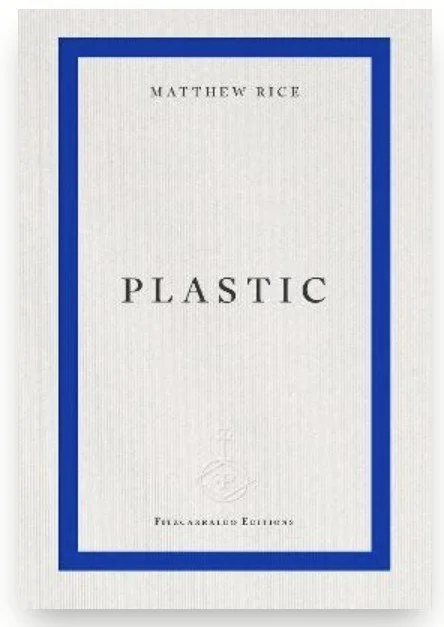
Recently published by Fitzcarraldo in January 2026, Matthew Rice’s plastic examines manual labour and social class through the lens of capitalist production. Rice was born in Belfast and holds a PhD from the Seamus Heaney Centre, Queen’s University Belfast. Rice previously worked in a plastic moulding factory for ten years, and it is this experience which plastic is based upon, bringing a somewhat uncommon, but vital perspective into contemporary UK poetry. Fitzcarraldo describes plastic as “a book-length poem exploring the life of the industrial worker turned poet”, blending “memoir, ekphrasis and satire”. plastic is Rice’s second full-length volume of poetry, following The Last Weather Observer in 2021, a critically acclaimed collection, which was highly commended by the Forward Prize and named as one of the top ten books of the year by the Arts Council of Northern Ireland. Rice has joined Fitzcarraldo under Rachael Allen’s newly established poetry list, with poets writing across Europe and North America, such as Dianne Seuss, Sasha Debevec-McKenney and Oluwaseun Olayiwola. The independent publisher, which launched in 2014, is already well regarded for its fiction and non-fiction lists, including Nobel laureates such as Annie Ernaux, Jon Fosse and Olga Tokarczuk.
Matthew Rice’s plastic is centred around a single twelve-hour night shift, detailing the physical and psychological impacts of working in a plastic factory. Rice splits the narrative into three separate sections, tracing a chronology from pre-work, to work and post-work. The speaker begins by describing his drive to the factory, before imagining the alternative versions of life he is aware of, but which are inaccessible on his current income. In the poem “[Night Shift]” the speaker states:
Always on the drive to the factory I visit
somewhere I’ve never been, Amsterdam
sometimes, a gust of gulls sown
over the Singelgracht; or to Ronda maybe[.]
The speaker shows his desire for a life beyond the quotidian demands of work, free to travel the world and experience different cultures. Within this imagined life, he envisages “another timeline where the matadors/ for good lay down their muletas”. Rice shows that his speaker is conscious of life’s various realities in and beyond the lived environment, wishing to escape and negate the economic and cultural violence of both spaces, whether it be the minimum-wage factory or the matador’s bullring.
The author underpins the collection with a clear focus on form, language and theory. He captures the voice and tone of his environment, writing in English before code switching into Eejit. Rice describes Eejit in plastic as “a phonetic writing system developed by the Belfast poet Scott McKendry befitting Belfast Vernacular English”. Writing within this style, each poem builds on the next in terms of narrative but differs through the use of form. Rice moves between short and longer poems, in addition to playing with typographical formatting. Some poems contain handwritten scrawls, and non-standard placement of words across the page, conveying a sense of immediacy, almost as if the poems were written in real time on the factory floor. This emphasises how “URGENT” the passage of time is to the speaker, akin to the “job card” that dictates his place within time and space when he enters the factory. Rice develops this point by structuring the book so that the poems before and after work are largely untitled, speaking to the insignificance of time outside of work in a capitalist framework. Once the speaker enters the factory, each poem is titled with a different time of night, marking the speaker’s progress through the shift. These poems are positioned like snapshots, archiving distinct moments of commentary and insight from within the workplace. At 20:00, the speaker steps inside the factory and states:
Once, in this building, a kid clocked off night shift
for good at the end of a rope,
another’s heart gave out at 3am.
performing a task as menial as mine.
This immediate fixation on death frames the speaker’s journey through time, which doubles as a movement through literal and figurative space. He passes through the factory as the hours progress, perceiving the ailing health of its workers, both physical and mental, with the workspace symbolising a Marxist underworld.
Marx prefaces The Critique of Political Economy with an opening quote from Dante’s Inferno, with critics, such as Rachel Falconer, identifying the workplace as a version of the underworld in Marx’s oeuvre. The exploitations of work equate to a katabatic journey, and Rice’s plastic can be read within this framework. Dante is directly referenced in the poem “21:03”, with katabatic poetics being developed throughout the book when characters are repeatedly exposed to injury and death through workplace hazards. The poem “21:07” opens with the line “Just as blood is always trying to escape”, describing the moment when a worker is crushed under a pallet that weighs over a ton. Then, later in the night, at 23:01, the speaker details less immediate and less visible dangers, although these are just as common, and arguably much more harmful:
while our lungs glow eerie as Hevea brasiliensis:
not marks the spot but skill and crossbones,
air-bound chemicals heavy with poison
magicked in that rumoured realm of
MAY CAUSE CANCER.
Whether it’s through the loss of blood or the slow growth of cancer, caused by the chemicals used in plastic production, Rice positions the workers among the dying and the dead. His speaker moves through the workplace, bearing witness to their misery and pain in a katabatic landscape, akin to Dante’s Inferno which guides readers down to, and through, the circles of Hell. Rice’s speaker epitomises this sentiment in the poem “23:23”, identifying “Hell as an idea of what work could be”.
The poet explores the psychic violence of the workspace, positioning it in direct opposition to a life of culture. Early in the shift, at 20:03, the speaker states “[…] my copy of Gawain/ is contraband”. The idea of literature as contraband is interesting and speaks to the work of Pierre Bourdieu, the French sociologist, who categorised social class into three components: economic capital, social capital and cultural capital. Bourdieu argued that these three categories distinguish a person’s social class, and we can see Rice exploring the tension among these categories. His speaker is economically working class, labouring in an unsafe and poorly-paid environment, while possessing the cultural interests of the middle class, taking his medieval literature to work. Through this depiction, Rice challenges the stereotypical concepts of social class, highlighting that the working class can live culturally enriched lives, and that they do not simply exist to work and then die. Literature, and culture more broadly, is positioned as an antithesis to the capitalist and katabatic exploitations of work as in the early Frankfurt School. Like contraband, it is a small item of resistance, highlighting the speaker’s interests and worth beyond the workplace.
Rice emphasises this point quite poignantly in the poem “05:29”, describing “[…] wee Gail’s seventieth birthday”, whose body is aged and worn “with having laboured/ in the same spot for so long”. The speaker observes the nimble skill of her hands as she works, stating:
her bench could be a grand piano
her patch of floor a stage
and in another life, it is.
The poet imagines the life this woman could have lived, had she been born into a different social class. At seventy years of age, she continues to work, and as something akin to a birthday present, Rice’s speaker gifts “wee” Gail – using the Northern Irish diminutive – her own form of contraband. Like the copy of Gawain hidden in the factory, he almost places the piano within touching distance of her aging hands. The author highlights his skill as a poet through this image, placing empathy and humanity at the centre of his writing. He does not simply focus on his own experience, but also that of his coworkers who are rendered vulnerable through time and age. These characters are used to test the pressure points of social class in modern society, highlighting that anyone, and everyone, should have access to literature and culture, regardless of their economic circumstances.
plastic allows us to explore the realities of low-paid labour and access to culture for the working class by leaning into the ambiguity and uncertainty of art. In the poem “04:04”, the speaker explores the possibilities of artistic imagination during the night shift:
In a reverie brought on by 4am.,
or the machines that bombinate
millennia through their cycles,
I’m back in the Ulster Museum
where you said, ‘In this period artists were taught
to discover black via colour’.
Rice uses the artists from the Ulster Museum as an inverted metaphor for the night shift. The speaker and his colleagues work through the night, isolated from the living and the literary world; while everyone else sleeps, they must labour. The poet occupies the black of night and explores its capacity for culture and creativity. The factory is a place of work and economic exploitation, but it can also be a space of creative development, allowing the writer to imagine, inhabit and reflect upon an area of society that is underrepresented in literature. Whether or not plastic becomes contraband for another worker, in another factory, in another time, Matthew Rice reclaims this space for his speaker. At 00:00, he declares that “[t]he night is proletarian/ a morgue of ghosts”, ushering us into the dark, where one by one, reader by reader, we travel through the pages, haunting the factory and its capitalist notions of class.